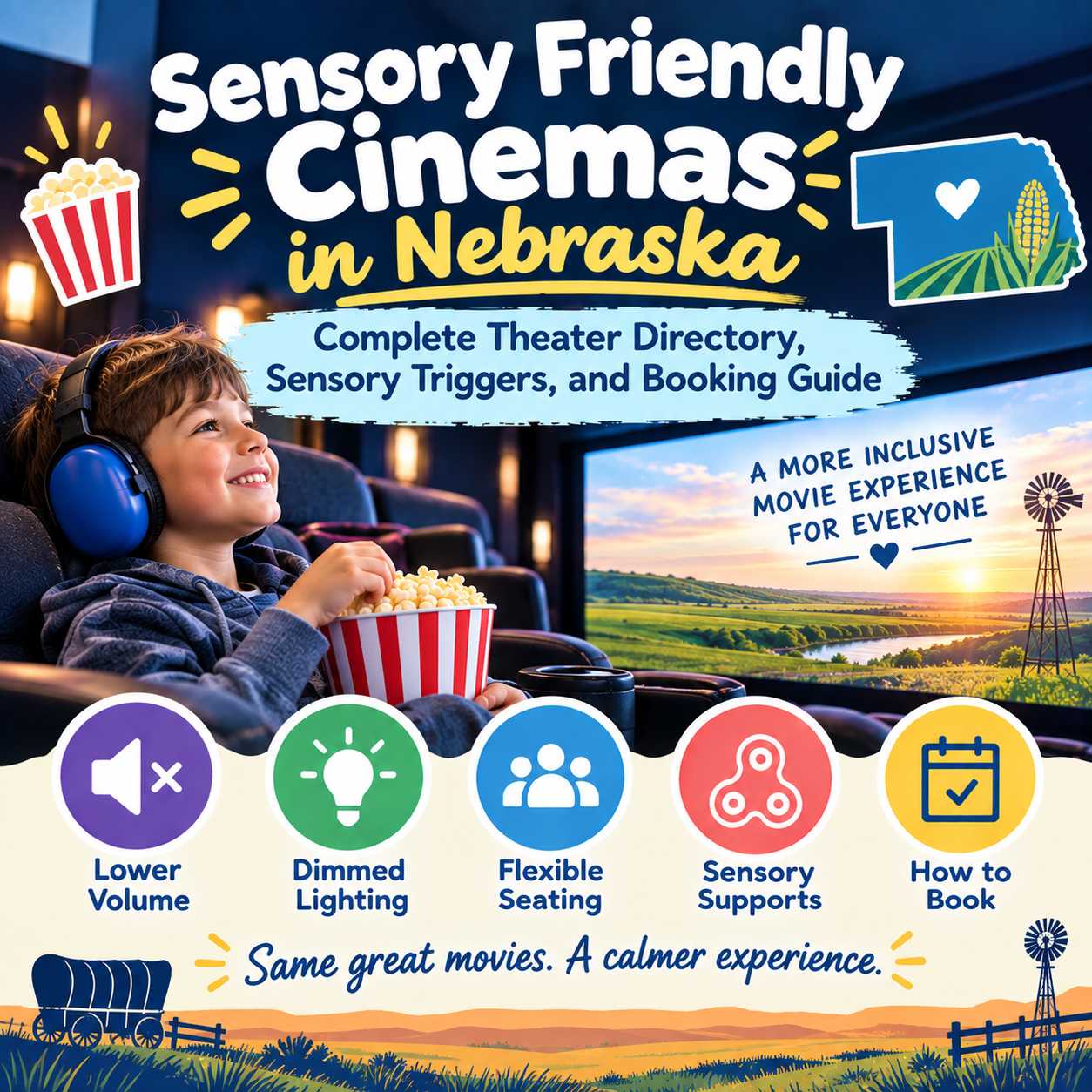
Sensory-Friendly Cinemas in Nebraska: The Complete Accessibility Guide
Discover sensory-adapted screenings across Marcus Theatres, Alamo Drafthouse, AMC Theatres, and Film Streams—engineered with softened acoustics, house lights left on, open movement policies, and zero pre-show marketing friction.
Nebraska Sensory-Friendly Theaters & Screening Hubs
Quick reference directory of regional venues, theater circuits, addresses, trending screening lineups, and regular schedule windows across Nebraska.
| Cinema & Circuit | City / Region | Address | Screening Feature | Schedule & Showtime |
|---|---|---|---|---|
| Marcus Majestic Cinema of Omaha | Omaha, Douglas County | 14304 W Maple Rd, Omaha, NE 68164 | Reel Movies for Real Needs (Trending Family Films) | Select Saturday Mornings |
| Marcus Village Pointe Cinema | Omaha / Elkhorn, Douglas County | 304 N 174th St, Omaha, NE 68118 | Reel Movies for Real Needs (First-Run Animation) | Select Saturday Mornings |
| Marcus Twin Creek Cinema | Bellevue, Sarpy County | 3909 Raynor Pkwy, Bellevue, NE 68123 | Reel Movies for Real Needs (Family Matinees) | Select Saturday Mornings |
| Marcus SouthPointe Cinema | Lincoln, Lancaster County | 2920 Pine Lake Rd, Lincoln, NE 68516 | Reel Movies for Real Needs (Studio Animations) | Select Saturday Mornings |
| Marcus East Park Cinema | Lincoln, Lancaster County | 220 N 66th St, Lincoln, NE 68505 | Reel Movies for Real Needs (Family Blockbusters) | Select Saturday Mornings |
| Marcus Grand Island Cinema | Grand Island, Hall County | 3404 W 13th St, Grand Island, NE 68803 | Reel Movies for Real Needs (Animated Releases) | Select Saturday Mornings |
| Alamo Drafthouse La Vista | La Vista, Sarpy County | 12750 Westport Pkwy, La Vista, NE 68138 | Sensory Friendly Screenings (Trending Family Lineup) | Select Weekend Matinees |
| AMC Oak View 24 | Omaha, Douglas County | 3555 S 140th St, Omaha, NE 68144 | Sensory Friendly Films (G/PG Family & PG-13/R Mature) | 2nd & 4th Sat AM (Family) / Select Wed PM (Mature) |
| AMC CLASSIC Council Bluffs 17 | Council Bluffs, IA (Metro Border) | 3220 23rd Ave, Council Bluffs, IA 51501 | Sensory Friendly Films (Studio Releases) | 2nd & 4th Sat AM / Select Wed PM |
| Film Streams Ruth Sokolof Theater | Downtown Omaha (NoDo) | 1340 Mike Fahey St, Omaha, NE 68102 | Relaxed Screenings (Family & Arthouse Titles) | Regularly Scheduled Community Dates |
| Film Streams Dundee Theater | Midtown Omaha | 4952 Dodge St, Omaha, NE 68132 | Relaxed Screenings (Open-Captioned Features) | Regularly Scheduled Community Dates |
A standard commercial cinema sound processor peaks near 105 decibels during an action sequence, while the auditorium plunges into total darkness. For a viewer with autism spectrum conditions, sensory processing differences, ADHD, or traumatic brain injury, that environment triggers acute physical distress. Families frequently discover this threshold the hard way: five minutes after the studio logos finish, walking back toward the parking lot holding an untouched soda and admission receipts they never had a chance to use.
Sensory friendly cinemas in Nebraska eliminate that sensory overload by altering the physical auditorium and discarding traditional commercial theater etiquette. Ambient lights stay lit at low levels, master sound runs capped to conversational thresholds, commercial previews disappear, and patrons pace aisles, stim, vocalize, or unpack dietary-specific snacks without reprimand from staff or fellow ticket holders.
Understanding which circuit operates what program across Greater Omaha, Lincoln and Lancaster County, Sarpy County (La Vista and Bellevue), Grand Island, and the Platte River corridor, how non-profit arts venues collaborate with inclusive initiatives like Common Senses, and where physical adaptations stop determines whether your outing succeeds or stalls at the box office door.
Screening Architecture: Standard vs. Sensory-Friendly Setup
- Audio Level: 100–105 dB dynamic peaks (Explosive bass & sudden volume spikes)
- Auditorium Space: Total blackout (Severe optical contrast glare)
- Pre-Show: 15–25 minutes of loud promotional ads & trailers
- Etiquette: Rigid silence & physical immobility strictly enforced
- Concessions: Commercial theater-only concession restrictions
- Audio Level: 70–80 dB conversational ceiling (Compressed peaks)
- Auditorium Space: House sconces left lit at ~50% ambient power
- Pre-Show: Zero promotional ads; feature begins right at showtime
- Etiquette: Vocalizing, stimming, walking, and pacing allowed
- Concessions: Outside dietary and medical food explicitly tolerated
What Actually Changes in a Sensory-Friendly Screening?
Standard cinema policies mandate absolute silence and rigid physical stillness, leading to compounding cognitive exhaustion. Sensory presentations invert these operating requirements.
Sound Compression
The projection team lowers master faders by ~20 dB, softening dynamic explosions and trimming surround speakers to prevent spatial disorientation.
Ambient Illumination
House lights stay at 50% throughout the film, minimizing optical contrast shocks from bright screens and ensuring safe aisle transit.
Zero Ad Trailers
High-volume commercial reels and third-party movie trailers are omitted entirely. The feature film begins immediately at the posted showtime.
Flipped Etiquette
Pacing wide carpeted aisles, vocalizing, stimming, or stepping out to decompress in outer hallways carries zero social reprimand.
Environmental Controls vs. On-Screen Filmmaking Triggers
The theater operator modifies room mechanics; it never re-edits the movie itself. Knowing where theater control ends allows you to select films and pack gear that target real vulnerabilities.
Environmental Factors (Managed by Venue)
- Loud Sounds: Master sound capped to ~70–80 dB
- Sudden Sounds: Trimmed speaker wattage softens spikes
- Darkness: Ambient house sconces stay illuminated
- Claustrophobia: Unlocked doors, free pacing, lower crowd density
Creative Filmmaking (Unchanged by Venue)
- Flashing Lights: Strobe cuts still emit from the projector lens
- Camera Movement: Handheld shakes & whip pans remain intact
- Rapid Cuts: High-cadence montage editing stays unedited
- Crowded Scenes & Body Horror: Graphic anatomical & visual clutter elements remain
| Sensory Trigger | Managed by Venue? | How the Venue Resolves It | Remaining Vulnerability & Practical Countermeasure |
|---|---|---|---|
| Loud Sounds | Yes (Direct) | Drops output from 100–105 dB to ~70–80 dB, dampening harsh bass channels. | Sustained action sequences still elevate above baseline; keep noise-canceling headphones ready. |
| Sudden Sounds | Partial | Lowered speaker wattage dampens explosive audio cues and abrupt jump scares. | Audio spikes still exist in the dynamic track; check script timings or parent advisory boards in advance. |
| Darkness | Yes (Direct) | Auditoriums do not black out; low, warm ambient house lights remain on. | Eliminates spatial disorientation; allows unassisted walking through rows and exits. |
| Claustrophobia | Yes (Direct) | Doors remain unlocked, aisles stay open, and attendance density is lower. | Book perimeter or aisle seats near exit doors so stepping into the lobby takes seconds. |
| Flashing Lights | Partial | Dim house lights reduce high-contrast glare between screen flash and room darkness. | On-screen strobes still emit; wear a brimmed hat or tinted lenses to soften peripheral flare. |
| Camera Movement | No | Unchanged by venue; handheld shake and rapid whip zooms remain in the cut. | Sit farther back to narrow field of view and prevent vestibular disorientation. |
| Rapid Cuts | No | Unchanged by venue; high-frequency montage editing remains intact. | Ambient room lighting softens visual fatigue by anchoring vision to auditorium walls. |
| Crowded Scenes | No (Film) / Yes (Room) | Footage is untouched, but open room seating gives physical breathing space. | Focus on physical grounding tools or step into the open lobby for a reset. |
| Body Horror | No | Unchanged by venue; narrative gore and visceral transformations run unedited. | Review trigger databases (e.g., DoesTheDogDie) or stick to PG family matinees. |
Major Commercial Chains Running Dedicated Programs in Nebraska
1. Marcus Theatres: Reel Movies for Real Needs
Marcus Theatres operates the most dominant multiplex circuit in Eastern and Central Nebraska, running its established “Reel Movies for Real Needs” accessibility program. Screenings run on select Saturday mornings with lower volume ceilings, brighter ambient house lights, DreamLounger recliner seating, and complete freedom to move, stim, and vocalize.
- Majestic Cinema of Omaha: 14304 W Maple Rd, Omaha, NE 68164 (Primary Douglas County multiplex hub).
- Village Pointe Cinema: 304 N 174th St, Omaha, NE 68118 (Serving West Omaha and Elkhorn).
- Twin Creek Cinema: 3909 Raynor Pkwy, Bellevue, NE 68123 (Serving Sarpy County and Offutt AFB).
- SouthPointe Cinema: 2920 Pine Lake Rd, Lincoln, NE 68516 (Serving South Lincoln and Lancaster County).
- East Park Cinema: 220 N 66th St, Lincoln, NE 68505 (Serving East Lincoln).
- Grand Island Cinema: 3404 W 13th St, Grand Island, NE 68803 (Serving Central Nebraska and Hall County).
2. Alamo Drafthouse Cinema: Sensory Friendly Screenings
Operating in Sarpy County just south of Omaha, Alamo Drafthouse provides structured sensory-friendly screenings designed for guests with sensory sensitivities and families with young children. Lights remain turned up, audio volume is softened, and the strict Alamo “no talking/no texting” policy is explicitly dropped, welcoming attendees to walk around, dance, and stim.
- Key Location: Alamo Drafthouse La Vista: 12750 Westport Pkwy, La Vista, NE 68138 (Convenient access off I-80 serving Sarpy and Douglas Counties).
3. AMC Theatres: Sensory Friendly Films (SFF)
AMC coordinates nationally with the Autism Society to operate a structured two-tiered accessibility calendar, ensuring sensory access extends beyond morning cartoons to evening major studio releases.
2nd & 4th Saturday morning (G or PG titles)
Select Wednesday evenings (PG-13 or R titles)
The Wednesday evening track provides essential access for neurodivergent teens, young adults, and older cinephiles who want to watch wide-release studio films without early morning hours or child-oriented lobby atmospheres.
- AMC Oak View 24: 3555 S 140th St, Omaha, NE 68144 (Serving Central and West Omaha).
- AMC CLASSIC Council Bluffs 17: 3220 23rd Ave, Council Bluffs, IA 51501 (Serving the eastern Omaha-Council Bluffs metro border).
- Ticketing: Look for the “Sensory Friendly Films” attribute tag on the AMC app and website.
4. Independent Non-Profit Spotlight: Film Streams (Omaha)
Film Streams is Omaha’s premier non-profit film organization, partnering directly with Common Senses to operate regular “Relaxed Screenings.” These screenings eliminate arcade noises and chaotic concession concourses entirely.
- Presentation Adjustments: House lights remain elevated, sound output is dialed down, and open-captioned subtitles are displayed directly on screen.
- Complimentary Sensory Kits: Check out sensory kits for free directly at the box office, including noise-canceling headphones, tactile fidgets, and stress-regulation tools.
- Ruth Sokolof Theater: 1340 Mike Fahey St, Omaha, NE 68102 (Downtown North Downtown / NoDo district).
- Dundee Theater: 4952 Dodge St, Omaha, NE 68132 (Midtown historic district).
Regional Nebraska Directory & Transit Logistics
Navigating transit in Nebraska requires selecting a venue with manageable arrival logistics and direct lobby access:
Marcus Majestic (W Maple Rd): Expansive flat surface parking lot right up to the front entrance.
Film Streams Ruth Sokolof: Surface lot and street parking in NoDo; quiet street frontage prevents sensory crowding.
Film Streams Dundee: Intimate midtown neighborhood parking behind the venue.
Alamo Drafthouse La Vista: Located at La Vista City Centre off I-80; garage and flat surface parking provide direct elevator and ground access.
Marcus Twin Creek (Bellevue): Standalone suburban site with open surface parking off Raynor Parkway.
Marcus SouthPointe (Lincoln): Park directly adjacent to the Pine Lake Road entrance to bypass open-air mall concourses.
Marcus Grand Island: Positioned along West 13th Street with broad, flat parking serving central Nebraska communities.
Strategic Toolkit: Packing for Sensory Regulation
Even when auditoriums maintain proper sensory modifications, every individual possesses distinct sensory thresholds. Packing an adaptive regulation toolkit ensures unexpected loud cues, temperature changes, or tactile discomfort can be handled immediately in your seat.
Over-ear noise-canceling headphones or passive high-attenuation earmuffs to buffer sudden orchestral peaks and sound spikes.
Brimmed cap to control overhead glare; polarized sunglasses or blue-light blocking lenses to soften high-contrast primary colors.
3–5 lb weighted lap blanket for nervous system calming, seamless compression sleeves, or silent silicone fidget tools.
Sensory chew necklaces, textured snacks, leak-proof hydration cups, and a dab of familiar essential oil on wrists to mask heavy lobby popcorn aromas.
Step-by-Step Preparation: Avoiding Box Office Friction
Sensory screenings eliminate barriers inside the theater room, but entering the facility and navigating ticketing can introduce friction. Implementing a methodical routine keeps the outing calm:
Confirm the Digital Schedule Tag Online (3–5 Days Prior)
When searching for showtimes, look for the specific program label rather than standard digital projection. Look for “Reel Movies for Real Needs” on Marcus Theatres, “Sensory Friendly” on Alamo Drafthouse, “Sensory Friendly Films” on AMC, or “Relaxed Screening” on Film Streams. Booking standard digital screenings by mistake means walking into total blackout and reference decibel spikes.
Call Local Management 24 Hours in Advance
Modern digital projection systems run automated playlist macros. If a floor manager forgets to assign the custom sensory macro to that projector, the auditorium will automatically trigger commercial blackout and reference volume levels. A brief call to confirm master sound is capped, house sconces are at half-power, and trailers are deleted prevents this mistake.
Choose Seats on the Aisle Near Exits
Book aisle seats located in the back third of the theater near the primary exit doors. This offers instant lobby access for quiet resets without disrupting rows, wide paths to pace while keeping eyes on the screen, and a narrower field of view that prevents motion sickness from rapid camera whip pans.
Pack the Sensory Regulation Kit (Day of Event)
Double-check your pack for charged headphones, brimmed caps or sunglasses, weighted lap pads, silent fidgets, and preferred dietary snacks and hydration.
Arrive 10 Minutes Past Advertised Showtime
Standard previews are omitted, so the feature starts right at the listed time. Theater lobbies remain overstimulating hubs full of buzzing arcade cabinets, digital menu boards, and popping corn. Arriving ten minutes after showtime lets you skip that lobby rush completely, scan your tickets, and walk directly to your seat.
Frequently Asked Questions
Are sensory-friendly screenings in Nebraska restricted to children?
No. Programs like AMC’s Wednesday evening sensory series specifically cater to older teens and adults with mature releases (rated PG-13 or R). Non-profit arthouse programs like Film Streams’ Relaxed Screenings in Omaha welcome adult cinephiles, college students, and autistic individuals of all ages. Marcus and Alamo Drafthouse weekend morning matinees also welcome neurodivergent adults.
Can I bring outside food and drinks into Nebraska movie theaters?
Yes. While chains like Marcus Theatres, AMC, and Alamo Drafthouse maintain standard concession rules, corporate policies provide accommodations for guests with medical, sensory, or dietary needs. This covers severe food allergies, texture selectivity, or specialized liquid diets. Pack items in personal bags, and inform the ticket taker that you are carrying necessary dietary accommodations.
What should we do if our guest becomes overwhelmed mid-movie?
Step directly into the lobby or outer hallway. Sensory-friendly auditoriums use open-door policies that allow patrons to leave and return at will. Non-profit venues like Film Streams (Dundee and Ruth Sokolof) feature quiet lobby corners and check out sensory kits with noise-canceling headphones to help decompress before returning to your seat.
Do sensory-friendly screenings cost more than regular tickets?
No. Sensory-friendly screenings do not carry premium ticket surcharges. Marcus Theatres bills Reel Movies for Real Needs at standard early-morning matinee rates, AMC charges standard matinee rates for morning shows and regular general admission for Wednesday evening presentations, and community organizations often offer low-cost, subsidized admissions.