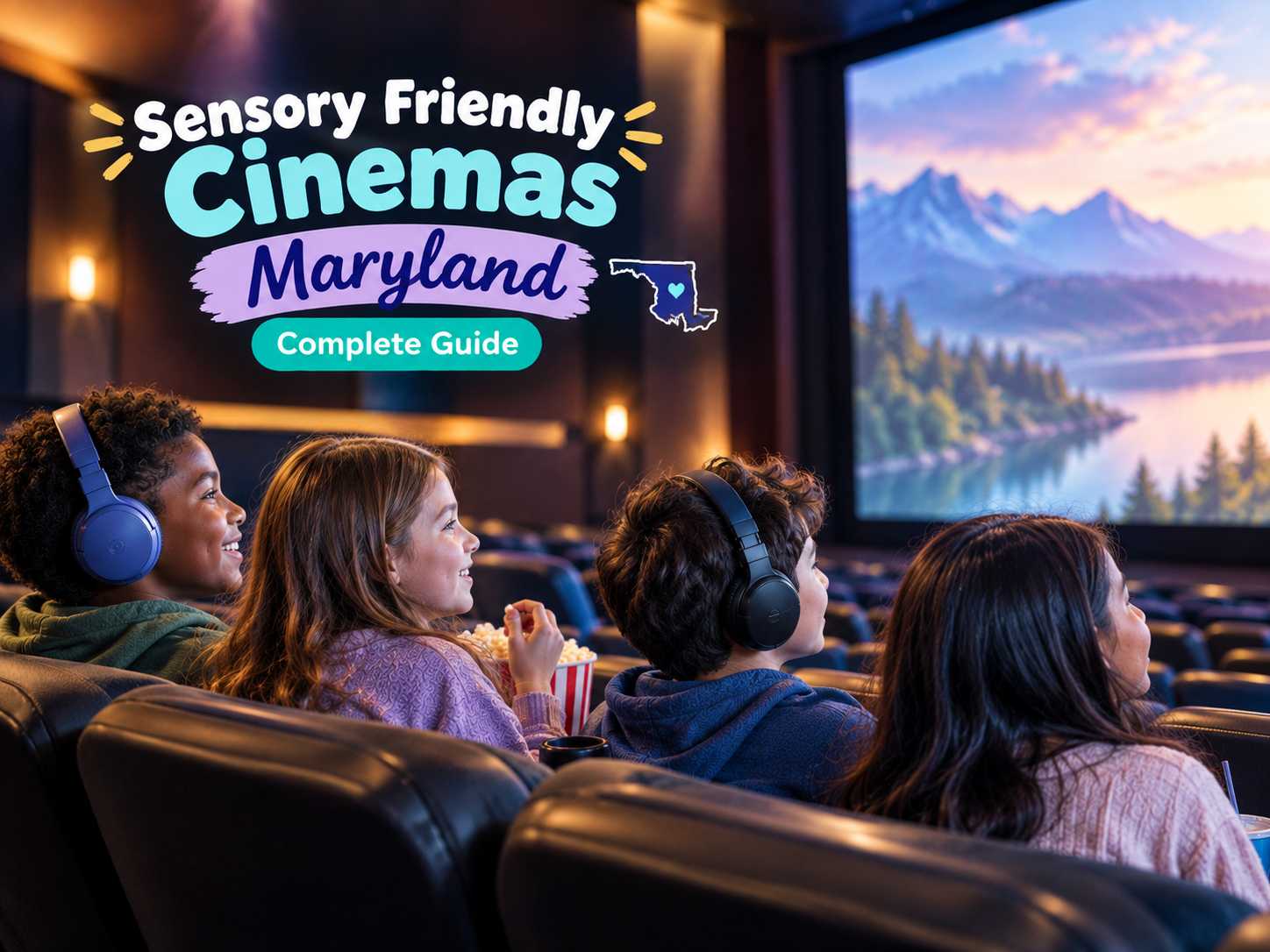
Sensory-Friendly Cinemas in Maryland: Complete Statewide Directory & Practical Guide
A comprehensive technical guide across the Baltimore Metro, Suburban Maryland, D.C. Exurbs, Western Maryland, and the Eastern Shore. Discover modified auditorium mechanics, outside food policies, and dedicated circuit schedules.
Maryland Sensory-Friendly Screenings Directory
Verified commercial circuits and independent community venues offering low-decibel, elevated-lighting presentations across Maryland.
| Cinema & Circuit | City / Region | Address | Screening Feature | Schedule & Showtime |
|---|---|---|---|---|
| AMC Columbia 14 | Columbia / Howard County | 10300 Little Patuxent Pkwy, 21044 | Shaun the Sheep / Forgotten Island / Verity | 2nd & 4th Sat AM (Family) / Select Wed PM (Mature) |
| AMC Owings Mills 17 | Owings Mills / Baltimore Co. | 10100 Mill Run Cir, 21117 | Shaun the Sheep / Forgotten Island | 2nd & 4th Sat AM (Family) / Select Wed PM |
| AMC White Marsh 16 | Baltimore / White Marsh | 8141 Honeygo Blvd, 21236 | Shaun the Sheep / Family Releases | 2nd & 4th Saturday morning |
| AMC Rio Cinemas 18 | Gaithersburg / Montgomery Co. | 9811 Washingtonian Blvd, 20878 | Shaun the Sheep / Verity (Wed) | 2nd & 4th Sat AM / Select Wed PM |
| AMC St. Charles Town Center 9 | Waldorf / Charles County | 11110 Mall Cir, 20603 | Shaun the Sheep: Beast of Mossy Bottom | 2nd & 4th Saturday morning |
| Regal Rockville Center | Rockville / Montgomery Co. | 199 E Montgomery Ave, 20850 | Shaun the Sheep: Beast of Mossy Bottom | First show on select Saturdays |
| Regal Hunt Valley | Cockeysville / Baltimore Co. | 11511 McCormick Rd, 21031 | First-Run Animated Matinees | First show on select Saturdays |
| Regal Waugh Chapel | Gambrills / Anne Arundel Co. | 1419 S Main Chapel Way, 21054 | Shaun the Sheep / Family Releases | First show on select Saturdays |
| Regal Westview | Frederick / Frederick County | 5243 Buckeystown Pike, 21704 | Shaun the Sheep: Beast of Mossy Bottom | First show on select Saturdays |
| Regal Valley Mall | Hagerstown / Washington Co. | 17301 Valley Mall Rd, 21740 | My Way Matinee Family Slate | First show on select Saturdays |
| Regal Salisbury | Salisbury / Wicomico (Eastern Shore) | 2322 N Salisbury Blvd, 21801 | Shaun the Sheep / Family Releases | First show on select Saturdays |
| Warehouse Cinemas Rotunda | Baltimore / Hampden | 711 W 40th St, 21211 | Studio Family Films (Open Captions) | Weekend daytime matinees |
| Warehouse Cinemas Leitersburg | Hagerstown / Washington Co. | 20145 Leitersburg Pike, 21742 | First-Run Family Features | Designated weekend matinees |
| Warehouse Cinemas Frederick | Frederick / Golden Mile | 1301 W Patrick St, 21702 | Open-Captioned Family Slates | Weekend daytime matinees |
| AFI Silver Theatre & Cultural Center | Silver Spring / Montgomery Co. | 8633 Colesville Rd, 20910 | Studio Releases & Classic Features | Scheduled sensory-friendly events |
| The Senator Theatre | Baltimore / Govans | 5904 York Rd, 21212 | Family-Accessible Community Screenings | Periodic partner community matinees |
A standard commercial cinema sound processor peaks near 105 decibels during an action sequence, while the auditorium plunges into total darkness. For a viewer with autism spectrum conditions, sensory processing differences, ADHD, or traumatic brain injuries, that environment triggers acute physical distress. Most families learn this boundary the hard way: five minutes after the studio logos finish, walking back toward the parking garage holding an untouched soda and admission receipts they never had a chance to use.
Sensory friendly cinemas in Maryland eliminate that friction by altering physical auditorium mechanics and discarding traditional commercial theater rules. Ambient wall sconces and overhead lights remain on at low levels, master sound runs capped to conversational thresholds, commercial trailers disappear, and patrons pace aisles, stim, vocalize, or unpack dietary-specific snacks without reprimand from staff or other ticket holders.
Understanding which circuit operates what program across the Baltimore metro, suburban Maryland, the Washington D.C. exurbs, Western Maryland, and the Eastern Shore, how independent venues handle outside food exceptions, and where physical adaptations stop determines whether your outing succeeds or stalls at the box office door.
Screening Environment Comparison
Standard Commercial Screening
- Audio Level: 100–105 dB peak volumes
- Auditorium Space: Total blackout conditions
- Pre-Show: 15–25 mins previews & ads
- Auditorium Etiquette: Strict silence & physical stillness
- Concession Rules: Theater-only concession rules
Sensory-Friendly Presentation
- Audio Level: 70–80 dB conversational cap
- Auditorium Space: House lights left at ~50%
- Pre-Show: Zero promotional ads or trailers
- Auditorium Etiquette: Vocalizing & pacing allowed
- Concession Rules: Outside dietary food tolerated
What Actually Changes in a Sensory-Friendly Screening?
Standard cinema policies mandate absolute silence and rigid physical confinement. Sensory presentations invert those constraints across four technical dimensions to relieve cognitive exhaustion.
Acoustic Compression
The projection team lowers the master fader by 20 to 30 decibels. This limits the dynamic ceiling, softening explosions and tire screeches, while surrounds are trimmed back to prevent spatial disorientation.
Half-Power Lighting
House sconces and overhead arrays remain illuminated at 50% power. This softens high-contrast optical glare between the projector beam and walls, enabling safe movement without flashlights.
Zero Commercial Reels
Commercial advertisements, local business promos, and loud trailers are omitted entirely. The movie starts immediately at the posted showtime, sparing guests 20 minutes of overstimulating marketing content.
Relaxed Social Space
The behavioral contract flips completely. Pacing down carpeted stairs, vocalizing during dialogue, hand flapping, or stepping outside to decompress carries zero social friction and complete staff support.
Environmental Controls vs. On-Screen Filmmaking Triggers
A sensory-friendly screening reconfigures physical auditorium mechanics, but never alters the cinematic cut. Knowing where theater control ends lets you prepare targeted personal countermeasures.
- Loud Sounds: Master sound capped to ~70–80 dB
- Sudden Spikes: Trimmed speaker wattage softens jumps
- Darkness: Ambient house lighting stays illuminated (~50%)
- Claustrophobia: Unlocked doors, free pacing, lower room density
- Flashing Lights: Strobe cuts still emit directly from lens
- Camera Movement: Handheld shake and whip pans stay in cut
- Rapid Cuts: High-frequency montage pacing runs intact
- Story Elements: Body horror, gore, and crowded visuals stay
| Sensory Trigger | Venue Managed? | How Venue Resolves It | Remaining Friction & Countermeasure |
|---|---|---|---|
| Loud Sounds | Yes (Direct) | Master sound drops from standard peak levels (~100–105 dB) to roughly 70–80 dB, dampening harsh bass channels. | Sustained action sequences still elevate above baseline; keep noise-canceling headphones ready. |
| Sudden Sounds | Partial | Lowered speaker wattage dampens explosive audio cues and jump scares, preventing sudden acoustic shock. | Audio spikes still exist in dynamic track; check script timings or parent advisory boards in advance. |
| Darkness | Yes (Direct) | Auditoriums do not black out. Low, warm ambient house lighting remains active from start to finish. | Eliminates spatial disorientation and allows unassisted walking through rows and exits. |
| Claustrophobia | Yes (Direct) | Doors remain unlocked, aisles stay open for pacing, and attendance density is generally lower. | Book perimeter or aisle seats near exit doors so stepping into the lobby takes seconds. |
| Flashing Lights | Partial | Dim house lights reduce high-contrast glare between the screen flash and the surrounding room. | On-screen strobes still emit; wear a brimmed hat or tinted lenses to soften peripheral flare. |
| Camera Motion | No (Film) | Unchanged by venue. Handheld shake, rapid pans, and whip zooms run as originally shot. | Sit farther back in the theater to narrow the field of view and prevent vestibular disorientation. |
| Rapid Cuts | No (Film) | Unchanged by venue. High-cadence montage editing remains intact. | Ambient room lighting softens visual fatigue by anchoring peripheral vision to fixed auditorium walls. |
| Crowded Scenes | Partial | The on-screen footage is untouched, though open auditorium seating gives physical breathing room between patrons. | Focus on physical grounding tools or step into the open lobby if dense crowds on screen cause stress. |
| Body Horror | No (Film) | Unchanged by venue. Narrative gore, visceral transformations, and medical imagery are completely unedited. | Review trigger databases (such as DoesTheDogDie) or stick to PG family matinees. |
Major Commercial Chains Running Dedicated Programs in Maryland
1. AMC Theatres: Sensory Friendly Films (SFF)
Operating in official partnership with the Autism Society, AMC runs a multi-tiered accessibility calendar across its Maryland footprint, offering two distinct tracks:
• Mature Screenings: Select Wednesday evenings (PG-13 or R titles for neurodivergent teens & adults)
Release Slate Examples: Shaun the Sheep: Beast of Mossy Bottom (PG Saturday morning), Forgotten Island (PG Saturday morning), and Verity (R-rated Wednesday evening).
Key Maryland Multiplex Hubs: AMC Columbia 14, AMC Owings Mills 17, AMC White Marsh 16, AMC Rio Cinemas 18 (Gaithersburg), and AMC St. Charles Town Center 9 (Waldorf). Outside food brought for dietary or sensory needs is routinely accommodated by local management.
2. Regal Cinemas: My Way Matinee
Regal provides daytime sensory-tailored access across Maryland through its My Way Matinee program on select Saturday mornings.
- Program Setup: Features the first scheduled screening of the day (e.g., Shaun the Sheep: Beast of Mossy Bottom), taking advantage of calm morning lobbies before peak crowds arrive.
- Pricing & Environment: House lights remain at half-power with stereo sound; tickets bill at early morning matinee rates ($8.49 to $14.25 depending on county market density).
3. Warehouse Cinemas: Sensory Friendly Screenings
A premier regional Maryland exhibitor delivering a modern, guest-first alternative to national megaplexes across Baltimore, Frederick, and Hagerstown.
- Integrated Open Captions: Subtitles are projected on-screen as a standard accommodation alongside dimmed lighting and capped sound.
- Lil’ Monster Club: First-time moviegoers receive a custom “First Movie Certificate” upon arrival at guest services.
- Full Conduct Flexibility: Stimming, chatter, pacing, late arrivals, and early departures are fully accommodated without judgment.
- Key Locations: Warehouse Cinemas Rotunda (Baltimore / Hampden), Warehouse Cinemas Frederick (Golden Mile), and Warehouse Cinemas Leitersburg (Hagerstown).
Independent & Non-Profit Cultural Venues
AFI Silver Theatre and Cultural Center
Location: 8633 Colesville Road, Silver Spring (Montgomery County)
Operated by the American Film Institute in downtown Silver Spring. An art-deco cultural landmark bypassing corporate arcade noise. Offers sensory-friendly screenings for studio releases and classic features with dim ambient lights, lowered audio, open captions, and noise-welcoming decorum.
The Senator Theatre
Location: 5904 York Road, Baltimore (Govans)
Baltimore’s historic 1939 art-deco landmark featuring an iconic main auditorium alongside three smaller, low-density screening rooms. Frequently partners with Baltimore-area advocacy organizations to run family-accessible matinees with controlled decibels and wide aisles.
Strategic Toolkit: Packing for Sensory Regulation
Even in modified theater environments, individual comfort thresholds differ. Having targeted regulation gear ready ensures sensory comfort throughout the entire screening.
Over-ear noise-canceling headphones or passive high-attenuation earmuffs to buffer sudden acoustic spikes and orchestral crescendos.
A brimmed baseball cap to shade peripheral screen flare, paired with polarized or blue-light blocking lenses to soften high-contrast primary glare.
A 3–5 lb weighted lap blanket for deep pressure input, along with seamless compression sleeves and silent silicone fidget tools.
Sensory chew necklaces, textured dietary-safe snacks, and an essential oil dab on wrists to mask heavy lobby popcorn aromas.
Step-by-Step Preparation: Avoiding Box Office Friction
A predictable pre-screening routine eliminates unexpected obstacles before entering the theater:
Confirm the Schedule Tag Online (3–5 Days Prior)
Verify the listing explicitly states Sensory Friendly Films (AMC), My Way Matinee (Regal), or Sensory Friendly (Warehouse Cinemas). Avoid mistakenly booking regular digital shows.
Call Local Management 24 Hours in Advance
Modern projection systems run automated playlist macros. Call the theater lead to confirm that the customized sensory macro is assigned to that projector—capping volume, maintaining half-power lighting, and deleting commercial trailers from ingest.
Pack an Emergency Sensory Regulation Kit
Assemble ear protection, sunglasses, weighted lap pads, silent tactile fidgets, and texture-safe snacks in a dedicated backpack ready to handle dynamic sound surges or physical restlessness.
Reserve Perimeter Aisle Seats Near Exits
Select aisle seats in the rear third of the auditorium. This provides immediate hallway access for quiet resets without disrupting rows, ample pacing room, and a narrower visual field of view.
Arrive 10 Minutes Past Advertised Showtime
Because sensory showings omit 20 minutes of promotional trailers, the film starts promptly. Arriving slightly after the posted time lets you bypass crowded lobby lines and arcade noise, entering directly as the movie starts.
Frequently Asked Questions
Are sensory-friendly screenings in Maryland restricted to children?
No. Programs like AMC’s Wednesday evening sensory series specifically cater to older teens and adults with mature releases (rated PG-13 or R). Adult moviegoers, autistic self-advocates, and individuals with sensory processing conditions are also welcome at all Saturday morning matinee presentations across commercial circuits and independent venues like the AFI Silver Theatre.
Can I bring outside food and drinks into Maryland movie theaters?
Chains like AMC, Regal, and Warehouse Cinemas maintain standard commercial concession rules, but corporate policies provide accommodations for guests with medical, sensory, or dietary needs (severe food allergies, texture selectivity, or specialized diets). Pack items in personal bags and politely inform the ticket taker that you are carrying necessary dietary accommodations.
What should we do if our guest becomes overwhelmed mid-movie?
Step directly into the lobby or outer hallway. Sensory-friendly auditoriums use open-door policies that let patrons leave and return at will. Independent non-profit venues like AFI Silver Theatre and The Senator Theatre feature quieter outer lobbies and wide hallways for decompressing before returning without pushback.
Do sensory-friendly screenings cost more than regular tickets?
No. Sensory-friendly screenings do not carry premium ticket surcharges. Warehouse Cinemas and Regal bill their accessibility shows at their standard early matinee rates ($8.49–$14.25), while AMC charges standard matinee rates for morning shows and regular general admission for Wednesday evening presentations. Historic cultural venues like AFI Silver offer tickets at standard non-profit admission tiers.