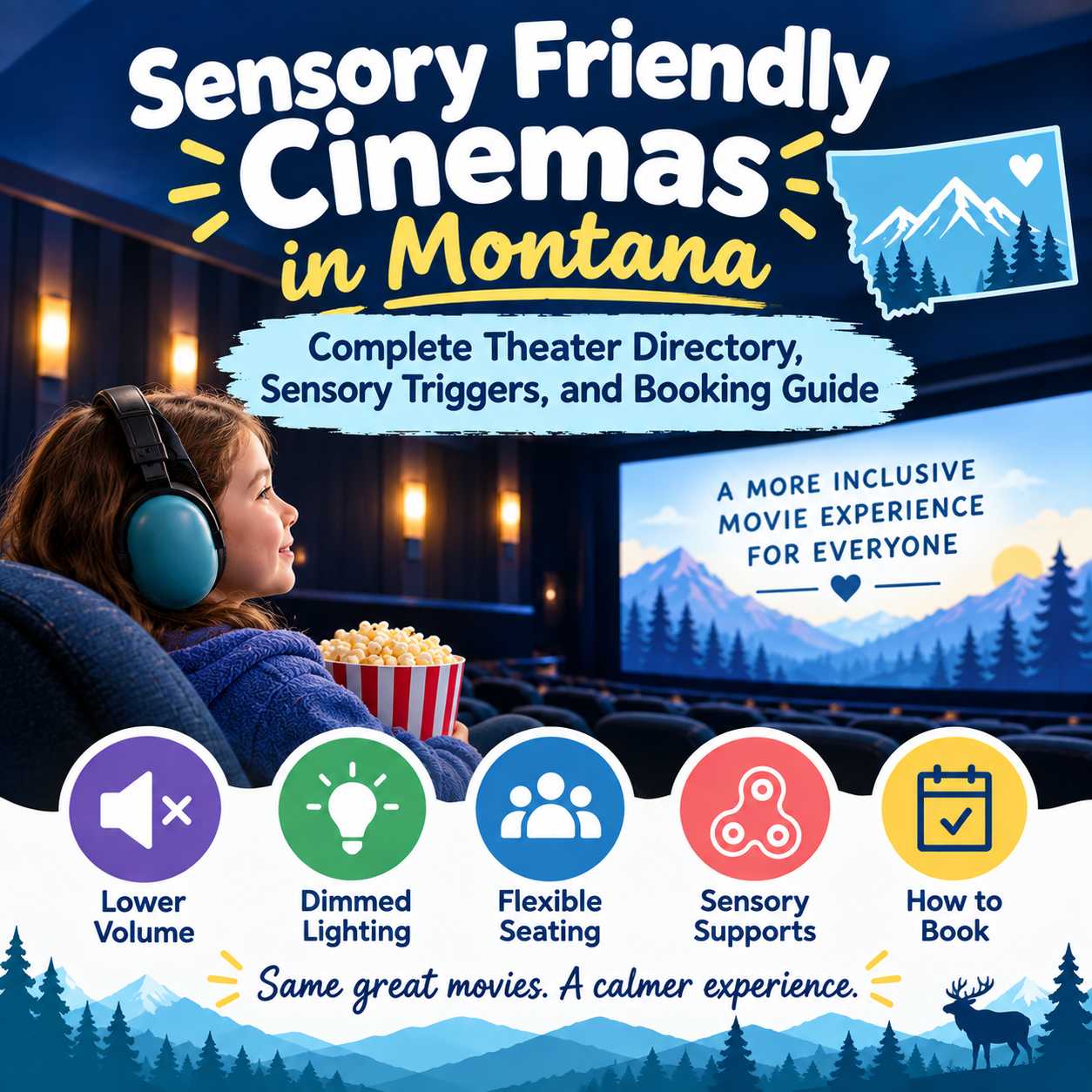
Sensory Friendly Cinemas in Montana: Complete Directory, Sensory Triggers & Booking Guide
A specialized accessibility guide and verified theater directory for patrons navigating autism, sensory differences, ADHD, and relaxed screenings across Montana.
Montana Sensory-Friendly Screening Schedule & Directory
Verified cinemas across Montana featuring adaptive, sensory-sensitive, and relaxed matinee showtimes.
Verified Montana Venues
| Cinema & Circuit | City / Region | Address | Screening Feature | Schedule & Showtime |
|---|---|---|---|---|
| AMC Shiloh 14 (Family Track) | Billings (Yellowstone County) | 1001 Shiloh Crossing Blvd, Billings, MT 59102 | The Wild Robot | 2nd & 4th Saturday • 10:00 AM |
| AMC Shiloh 14 (Mature Track) | Billings (Yellowstone County) | 1001 Shiloh Crossing Blvd, Billings, MT 59102 | Dune: Part Two | Select Wednesday • 7:00 PM |
| The Roxy Theater | Missoula (Missoula County) | 718 S Higgins Ave, Missoula, MT 59801 | Inside Out 2 | Seasonal Weekend • 11:00 AM |
| Cinemark Helena (Cinemark 10) | Helena (Lewis & Clark County) | Regional Multiplex, Helena, MT | Despicable Me 4 | Coordinated Saturday • 10:00 AM |
| The Ellen Theatre / Bozeman Film Society | Bozeman (Gallatin Valley) | 17 W Main St, Bozeman, MT 59715 | Community Family Matinee | Monthly Matinee • 1:00 PM |
| The Myrna Loy Center | Downtown Helena | 15 N Ewing St, Helena, MT 59601 | Relaxed Independent Feature | Select Sunday • 2:00 PM |
Note: Schedules align with major studio theatrical runs and community calendar dates. Always verify the specific “Sensory Friendly Films” tag with the theater box office prior to attending.
A standard commercial cinema sound processor peaks near 105 decibels during an action sequence, while the auditorium plunges into total darkness. For a viewer with autism spectrum conditions, sensory processing differences, ADHD, or traumatic brain injury, that environment triggers acute physical distress. Families frequently discover this threshold the hard way: five minutes after the studio logos finish, walking back toward the parking lot holding an untouched soda and admission receipts they never had a chance to use.
Sensory friendly cinemas in Montana eliminate that sensory overload by altering the physical auditorium and discarding traditional commercial theater etiquette. Ambient lights stay lit at low levels, master sound runs capped to conversational thresholds, commercial previews disappear, and patrons pace aisles, stim, vocalize, or unpack dietary-specific snacks without reprimand from staff or fellow ticket holders.
Understanding which circuit operates what program across Billings, Missoula, Bozeman, Great Falls, and Helena, how local non-profits and independent venues coordinate accessibility efforts, and where physical adaptations stop determines whether your outing succeeds or stalls at the box office door.
Standard Screening vs. Sensory-Friendly Setup
- Audio Level: 100–105 dB peak volume
- Auditorium Space: Total blackout room
- Pre-Show: 15–25 mins previews & promotional ads
- Etiquette: Strict silence & physical stillness
- Concessions: Theater-only concession rules
- Audio Level: 70–80 dB conversational cap
- Auditorium Space: House lights left at ~50%
- Pre-Show: Zero promotional ads or trailers
- Etiquette: Vocalizing & pacing allowed
- Concessions: Outside dietary foods tolerated
What Actually Changes in a Sensory-Friendly Screening?
Standard cinema policies mandate absolute silence and rigid physical stillness. For neurodivergent moviegoers, forcing the body into immobility while processing overwhelming sensory inputs causes compounding cognitive exhaustion. Sensory presentations invert those operating requirements:
Audio Processor Compression
The projection team lowers the master fader on the cinema processor, dropping output by roughly 20 decibels. Dynamic ceiling compression softens low-frequency explosions, screeching tires, and piercing orchestral stabs, while side surrounds are trimmed back to prevent spatial disorientation.
50% House Illumination
House illumination stays at approximately half-power throughout the presentation. Retaining ambient light reduces optical contrast between dark perimeters and bright projector beams, shielding viewers from optical shock and allowing safe aisle navigation without fumbling.
Zero Commercial Trailers
Pre-show commercial reels, local advertisements, and loud third-party movie trailers are omitted entirely. The feature begins immediately at the posted showtime, sparing guests twenty minutes of fast-paced, high-volume marketing content.
Relaxed Behavioral Rules
Crucially, the behavioral contract inside the auditorium flips. Walking down carpeted stairs, vocalizing during dialogue, hand flapping, or stepping into outer corridors to decompress carries zero social penalty or reprimand from staff.
Environmental Controls vs. On-Screen Filmmaking Triggers
A sensory-friendly screening fundamentally separates sensory friction into two distinct buckets: environmental factors the theater controls and creative filmmaking choices it cannot change. The theater operator modifies room mechanics. It never re-edits the movie itself.
Environmental Factors (Managed by Venue)
- Loud Sounds: Master sound capped to ~70–80 dB conversational threshold
- Sudden Sounds: Trimmed speaker wattage cushions acoustic spikes
- Darkness: Ambient house lighting stays illuminated at ~50%
- Claustrophobia: Unlocked doors, free pacing, and lower attendance density
Creative Filmmaking (Unchanged by Venue)
- Flashing Lights: Strobe cuts still emit directly from the lens
- Camera Movement: Handheld shake and whip pans stay in the cut
- Rapid Cuts: High-frequency montage pacing runs intact
- Crowded Scenes: Dense on-screen visual clutter remains
- Body Horror: Graphic anatomical elements and gore remain unedited
Knowing where theater control ends allows you to select films and pack gear that target real vulnerabilities:
| Sensory Trigger | Managed by Venue? | How the Venue Resolves It | Remaining Vulnerability & Practical Countermeasure |
|---|---|---|---|
| Loud Sounds | Yes (Direct) | Master sound drops from standard peak levels (~100–105 dB) to roughly 70–80 dB, dampening harsh bass channels. | Sustained action sequences still elevate above baseline; keep noise-canceling headphones ready for sustained crescendos. |
| Sudden Sounds | Partial | Lowered speaker wattage dampens explosive audio cues and jump scares, preventing sudden acoustic shock. | Audio spikes still exist in the dynamic track; check script timings or parent advisory boards in advance. |
| Darkness | Yes (Direct) | Auditoriums do not black out. Low, warm ambient house lighting remains active from start to finish. | Eliminates spatial disorientation and allows unassisted walking through rows and exits. |
| Claustrophobia | Yes (Direct) | Doors remain unlocked, aisles stay open for pacing, and attendance density is generally lower. | Book perimeter or aisle seats near exit doors so stepping into the lobby takes seconds. |
| Flashing Lights | Partial | Dim house lights reduce high-contrast glare between the screen flash and the surrounding room. | On-screen strobes still emit directly from the lens; wear a brimmed hat or tinted lenses to soften peripheral flare. |
| Camera Movement | No | Unchanged by venue. Handheld shake, rapid pans, and whip zooms run as originally shot. | Sit farther back in the theater to narrow the field of view and prevent vestibular disorientation. |
| Rapid Cuts | No | Unchanged by venue. High-cadence montage editing remains intact. | Ambient room lighting softens visual fatigue by anchoring peripheral vision to fixed auditorium walls. |
| Crowded Scenes | No (Film) / Yes (Room) | The on-screen footage is untouched, though open auditorium seating gives physical breathing room between patrons. | If dense visual crowds on screen cause stress, focus on physical grounding tools or step into the open lobby. |
| Body Horror | No | Unchanged by venue. Narrative gore, visceral transformations, and medical imagery are completely unedited. | Review trigger databases (such as DoesTheDogDie) or stick to PG family matinees to bypass visceral graphic content. |
Major Commercial Chains Running Dedicated Programs in Montana
Montana’s commercial theatrical circuit features regional multiplexes and national exhibitors, led by AMC Theatres in Billings alongside regional independent theater operators.
1. AMC Theatres: Sensory Friendly Films (SFF)
AMC partners nationally with the Autism Society to offer a structured, two-tiered accessibility calendar. Rather than limiting sensory screenings exclusively to Saturday morning animated titles, AMC operates two distinct tracks:
2nd & 4th Saturday morning (G or PG studio releases)
Select Wednesday evenings (PG-13 or R titles for teens & adults)
The Wednesday evening program provides essential access for neurodivergent teens, young adults, and older cinephiles who want to watch wide-release studio films without early morning hours or child-oriented lobby atmospheres.
- Key Montana Hub: AMC Shiloh 14: 1001 Shiloh Crossing Blvd, Billings, MT 59102 (Serving Yellowstone County and South-Central Montana).
- Ticketing & Booking: Digital tickets carry the dedicated “Sensory Friendly Films” attribute tag on the AMC mobile app and online web portal. Reserved seating allows early reservation of perimeter aisle positions.
- Outside Food Guidelines: Commercial policies prioritize concession purchases, but outside food brought for dietary, swallowing, or sensory accommodations is routinely permitted. Keeping items in personal bags avoids confusion.
2. Regional Multiplex Circuits (Cinemark & Regional Hubs)
Cinemark and affiliated regional operators serve key markets like Helena and Western Montana, offering periodic accessibility accommodations and sensory-friendly morning screenings.
- Cinemark Helena (Cinemark 10): Helena, MT (Periodically coordinates sensory-sensitive and family film dates).
- Program Setup: Features dimmed house lighting, moderate volume caps, and an understanding auditorium environment where guests can move about freely.
Montana Commercial Program Comparison
| Exhibitor | Program Name | Montana Schedule Window | Distinct Feature |
|---|---|---|---|
| AMC Theatres | Sensory Friendly Films | 2nd & 4th Sat AM (Family); Select Wed PM (Mature PG-13/R) | Wednesday evening adult track for older audiences; flagship Shiloh Crossing multiplex |
| Cinemark Theatres | Sensory-Sensitive Screenings | Coordinated seasonal and weekend dates | Regional capital presence serving Helena and surrounding counties |
Independent and Regional Non-Profit Venues Across Montana
Beyond corporate multiplexes, Montana is home to historic, community-supported independent cinemas that partner with regional disability advocacy groups and local autism support networks to provide inclusive cinematic experiences.
The Roxy Theater (Missoula)
718 S Higgins Ave, Missoula, MT 59801
A historic, multi-screen community art house avoiding corporate multiplex sensory chaos—no arcade machines, neon video walls, or overpowering industrial concession queues. Regularly partners with local advocacy networks for relaxed screenings.
The Ellen Theatre & Bozeman Film Society
17 W Main St, Bozeman, MT 59715
Coordinates seasonal community screenings with relaxed theater settings, welcoming atmospheres, and accessible seating in the heart of Gallatin Valley.
The Myrna Loy Center (Helena)
15 N Ewing St, Helena, MT 59601
Community-oriented historic arts cinema offering independent film screenings with smaller crowds, relaxed auditorium protocols, and manageable lobby environments.
Regional Montana Directory: Key Locations by Area
Navigating transit across Big Sky Country along the I-90 and I-15 highway corridors requires planning for travel distances, winter weather, and arrival logistics:
AMC Shiloh 14 • Extensive flat surface parking with ground-level entry.
The Roxy Theater • Intimate street & neighborhood parking with low sensory stress.
The Ellen Theatre • Historic downtown cinema arts and community hubs.
Cinemark Helena & The Myrna Loy • Central parking serving Lewis and Clark County.
Sensory Regulation Kit: Recommended Gear
- Auditory Dampening Gear: Over-ear noise-canceling headphones or passive high-attenuation earmuffs to buffer sudden acoustic crescendos.
- Visual Glare Filters: Standard baseball cap (tilting the brim controls overhead screen flare), polarized sunglasses, or blue-light blocking lenses.
- Proprioceptive & Tactile Aids: Weighted lap blanket or pad (3–5 lbs) for calming deep pressure input, seamless compression sleeves, or silent silicone fidget toys.
- Oral Tools & Dietary Snacks: Sensory chew necklaces, texture-safe familiar snacks, and leak-proof hydration cups.
- Olfactory Masking: A subtle dab of essential oil on the wrist to counteract pungent lobby popcorn and industrial butter aromas.
Step-by-Step Preparation: Avoiding Box Office Friction
-
Confirm the Digital Schedule Tag Online (3–5 Days Prior):
Look specifically for the dedicated “Sensory Friendly Films” tag on AMC’s app or web portal rather than regular digital listings. On community platforms like The Roxy, verify accessibility dates to avoid entering an uncompressed reference presentation.
-
Call Local Management 24 Hours in Advance:
Modern digital projection systems run automated playlist macros. Call and ask for a floor manager or projection lead to confirm that the custom sensory macro (master sound lowered ~20 dB, house sconces at half-power, commercial ads deleted) is correctly assigned to the auditorium playlist.
-
Pack Personal Sensory Equipment (Day of Event):
Even with lowered volume, soundtracks experience dynamic spikes. Keep noise-canceling headphones, brimmed caps, weighted pads, and familiar snacks organized in a dedicated, accessible regulation bag.
-
Choose Seats on the Aisle Near Exits:
Reserve seats in the back third of the auditorium near exit doors. This offers instant lobby access for quiet resets without disrupting rows, space to pace along side aisles, and a narrowed field of view that prevents motion sickness.
-
Arrive Ten Minutes After Advertised Showtime:
Sensory screenings eliminate trailers, starting the feature promptly. However, theater lobbies remain overstimulating hubs with loud arcade games and popping kettles. Arriving ten minutes late lets you bypass the lobby rush and walk directly to your seats as the film begins.
Frequently Asked Questions
No. Programs like AMC’s Wednesday evening sensory series specifically cater to older teens and adults with mature releases (rated PG-13 or R). Adult moviegoers, autistic self-advocates, and individuals with sensory processing conditions are also welcome at all Saturday morning matinee presentations across commercial and non-profit community venues.
Yes. Chains like AMC maintain commercial concession guidelines, but corporate and ADA policies provide clear accommodations for guests with medical, sensory, or dietary needs. This covers severe food allergies, texture selectivity, or specialized nutritional diets. Pack items in personal bags and quietly inform floor staff that you are carrying necessary dietary accommodations.
Step directly into the lobby or outer hallway. Sensory-friendly auditoriums use open-door policies that allow patrons to leave and return freely without judgment. Community venues like The Roxy in Missoula offer quiet lounge spaces to decompress before heading back inside.
No. Sensory-friendly screenings do not carry premium ticket surcharges. AMC bills morning family screenings at standard early-morning matinee rates and regular general admission for Wednesday evening presentations. Community non-profit screenings are frequently offered at accessible or subsidized rates.