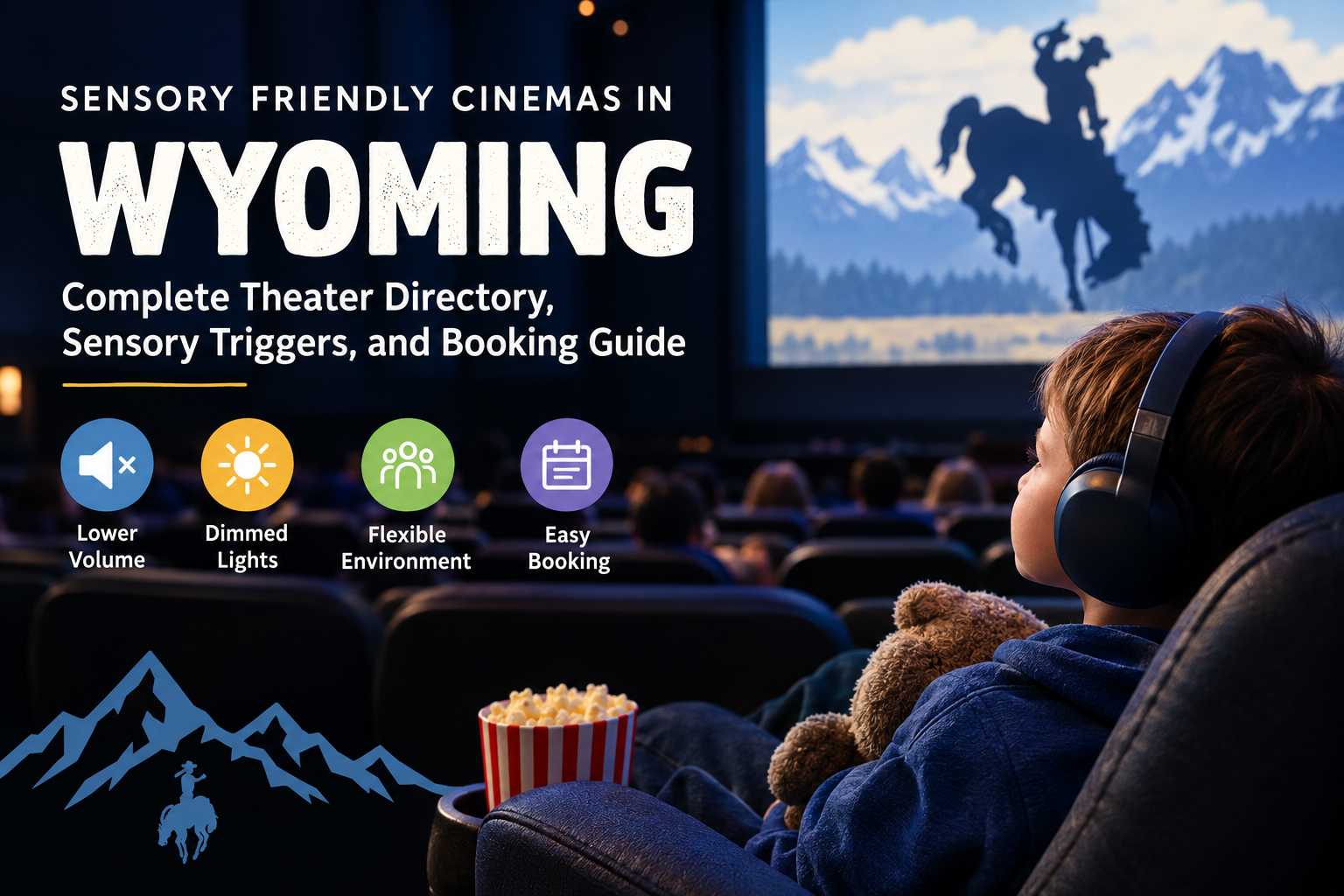
Sensory Friendly Cinemas in Wyoming: Complete Directory, Sensory Triggers & Booking Guide
A specialized directory and accessibility guide for moviegoers navigating sensory sensitivities, autism, ADHD, and neurodivergent-friendly screenings across Wyoming.
Wyoming Sensory-Friendly Screening Schedule & Directory
Current directory of participating Wyoming theaters, screening titles, dates, and showtimes.
Verified Wyoming Venues
| Cinema & Circuit | City / Location | Address | Screening Feature | Schedule & Showtime |
|---|---|---|---|---|
| Studio City Mesa (WyoMovies) | Casper, WY | 3150 Talon Dr | Inside Out 2 | Saturday • 10:30 AM |
| Capitol Cinema 16 (WyoMovies) | Cheyenne, WY | 3410 W Lincolnway | Despicable Me 4 | Saturday • 10:00 AM |
| Studio City UW (WyoMovies) | Laramie, WY | 2433 Grand Ave | The Wild Robot | Sunday • 11:00 AM |
| Studio City Stadium 10 (WyoMovies) | Casper, WY | 5020 E 2nd St | Kung Fu Panda 4 | Saturday • 10:15 AM |
| Star Stadium 10 (WyoMovies) | Rock Springs, WY | Sweetwater County Corridor | Moana 2 | Saturday • 10:30 AM |
| MovieWorks Cinema (Jackson Theatres) | Jackson, WY | 860 S Hwy 89 | Family Matinee Series | First Sunday • 11:30 AM |
| Center for the Arts | Jackson, WY | 265 S Cache St | Adapted Community Screening | Monthly Sat • 1:00 PM |
| The Historic Rialto & America Theater | Casper, WY | 102 S Center St | Heritage Family Matinee | Seasonal Sunday • 1:00 PM |
Note: Screening schedules and feature releases rotate periodically. Contact theater box offices to confirm program tags prior to arrival.
A standard commercial cinema sound processor peaks near 105 decibels during an action sequence, while the auditorium plunges into total darkness. For a viewer with autism spectrum conditions, sensory processing differences, ADHD, or traumatic brain injury, that environment triggers acute physical distress. Families frequently discover this threshold the hard way: five minutes after the studio logos finish, walking back toward the parking lot holding an untouched soda and admission receipts they never had a chance to use.
Sensory friendly cinemas in Wyoming eliminate that sensory overload by altering the physical auditorium and discarding traditional commercial theater etiquette. Ambient lights stay lit at low levels, master sound runs capped to conversational thresholds, commercial previews disappear, and patrons pace aisles, stim, vocalize, or unpack dietary-specific snacks without reprimand from staff or fellow ticket holders.
Standard Screening vs. Sensory-Friendly Setup
- Peak Audio: 100–105 dB
- Lighting: Total blackout
- Pre-Show: 15–25 mins loud ads
- Etiquette: Strict silence & immobility
- Peak Audio: 70–80 dB conversational cap
- Lighting: House lights kept at ~50%
- Pre-Show: Zero commercial trailers
- Etiquette: Vocalizing & pacing allowed
What Actually Changes in a Sensory-Friendly Screening?
Standard cinema policies mandate absolute silence and rigid physical stillness. For neurodivergent moviegoers, forcing the body into immobility while processing overwhelming sensory inputs causes compounding cognitive exhaustion. Sensory presentations invert those operating requirements:
1. Calibrated Sound Processor
Projection teams lower the master fader by roughly 20 decibels. Dynamic ceiling compression softens sudden explosions, while surround speakers are trimmed back to prevent spatial disorientation.
2. 50% House Illumination
Retaining warm ambient light prevents optical shock during scene changes, keeps peripheral vision anchored, and allows attendees to move safely without fumbling in the dark.
3. Zero Commercial Trailers
Features start immediately at the posted showtime. Guests bypass twenty minutes of overstimulating, high-volume advertisements and rapid montage reels.
4. Flipped Behavioral Contract
Stimming, walking along aisles, vocalizing, and stepping into the lobby for sensory resets carry zero judgment or social penalty from staff or guests.
Sensory Experience: Theater Controls vs. Filmmaking Triggers
A sensory-friendly screening alters room mechanics, but it never re-edits the movie itself. Knowing where venue control ends allows families to prepare practical personal accommodations:
| Sensory Trigger | Managed by Venue? | How the Venue Resolves It | Practical Countermeasure |
|---|---|---|---|
| Loud Sounds | Yes (Direct) | Sound drops to ~70–80 dB; bass dampening applied. | Keep noise-canceling headphones ready for sustained musical crescendos. |
| Sudden Sounds | Partial | Lower wattage cushions sudden audio spikes. | Review script timings or family advisory websites in advance. |
| Darkness | Yes (Direct) | Warm ambient lighting remains illuminated throughout. | Enables unassisted movement and rapid egress to exit corridors. |
| Flashing Lights | Partial | Dim house lighting reduces high-contrast optical glare. | Wear a brimmed hat or polarized lenses to soften direct screen flashes. |
| Camera Shake | No | Unchanged by venue; creative cuts run intact. | Sit farther back to narrow field of view and prevent vestibular disorientation. |
| Body Horror / Clutter | No | Original narrative imagery is never re-edited. | Screen ratings beforehand or choose PG family animated matinees. |
Sensory Regulation Kit: Recommended Gear
- Auditory Dampening: Over-ear noise-canceling headphones or passive high-attenuation ear defenders.
- Visual Filters: Baseball cap or visor (brim blocks projector lens flaring), tinted or blue-light lenses.
- Proprioceptive Aids: Weighted lap pad (3–5 lbs) for calming deep pressure input during seated periods.
- Tactile & Oral Tools: Silent silicone fidget toys, chew necklaces, and texture-safe snacks.
- Olfactory Masking: A subtle dab of essential oil on the wrist to counteract pungent cinema popcorn butter.
5-Step Guide to a Smooth Outing
- Confirm the Tag Online: Look specifically for “Sensory Friendly” or “Access Matinee” labels on WyoMovies or ticketing portals.
- Call Management 24 Hours in Advance: Digital projectors use automated macros. Ask the floor manager to verify that the custom sensory playlist macro (audio capped, house lights up, zero trailers) is cued up.
- Pack Dietary Needs: Theater policies and ADA regulations accommodate guests with medical or sensory food requirements.
- Book Rear Aisle Seats: Choose seats near the exits in the back third of the room for quick lobby decompression and minimal visual distortion.
- Arrive 10 Minutes Late: Trailers are eliminated, but lobbies can be chaotic. Arrive just past the posted start time to skip ticketing crowds and head straight to your seat.
Frequently Asked Questions
No. While morning screenings often showcase family-friendly movies, patrons of all ages—including neurodivergent teens, adults, and individuals recovering from head trauma or sensory processing challenges—are welcome.
Yes. Commercial circuits and ADA guidelines permit guests with sensory, texture-specific, or medical diets to bring personal food items. Inform the front desk upon entry that you have dietary accommodations.
No. Sensory-friendly showings carry no additional fees and are billed at standard morning matinee rates.